Towards coordinated international policy approaches to support research software: Highlights from the OECD workshop
By Michelle Barker
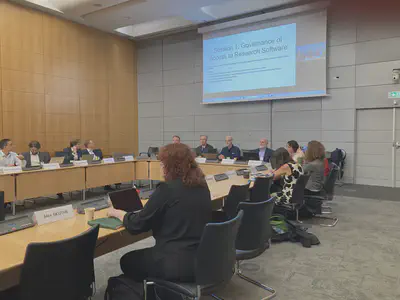
On 8 September 2025, the OECD hosted a landmark hybrid event titled Access to Research Software: Opportunities and Challenges in Paris. This workshop marked the launch of a new initiative under the Committee for Scientific and Technological Policy (CSTP) and builds on a strong legacy of OECD work on open science. This includes the 2006 Recommendation on Access to Research Data from Public Funding as well as its 2021 update, which was extended to include research software.
The event opened with remarks by Jerry Sheehan, OECD Director for Science, Technology, and Innovation, who emphasised that research software is now at the heart of scientific inquiry, and a fundamental research output in its own right. Sheehan noted that OECD analysis shows that one-third of all scientific outputs involve new code, a figure that rises to 65% in computer science. Consequently, equitable access to well-documented, reproducible software is foundational for the future of science, particularly in an era of AI-driven discovery.
The day was structured around five thematic sessions: governance, infrastructure, human resources, standards, and public-private partnerships (see also summaries by Alan Paic (OECD) and the European Virtual Institute for Research Software Excellence (EVERSE)). These pillars helped frame the policy, technical, and social challenges in ensuring sustainable access to research software**.** The workshop gathered over 170 participants-31 speakers on site and more than 140 online-from academia, industry, research infrastructures, funding agencies, and policy bodies across the globe. As highlighted by Carole Goble (University of Manchester), “it takes a village"-or rather, interconnected villages-working together across silos to make research software accessible and sustainable.
1. Governance: Who’s Responsible for Research Software?
The first thematic session considered governance issues. Moderated by Daniel S. Katz (University of Illinois Urbana-Champaign), it tackled the difficult question of who is accountable for sustaining research software, and how to ensure it remains accessible. Panelists Roberto Di Cosmo (Software Heritage), Nonia Pariente (PLOS Biology), Ioana Spanache (Executive Agency for Higher Education, Research, Development and Innovation Funding (UEFISCDI)), and Fabio Kon (University of São Paulo) examined various governance models, ranging from open-source to commercial.
A key takeaway was that governance must balance access and sustainability. While open access is a worthy goal, without long-term funding and institutional support, software often collapses under the weight of neglect. Panelists called for clear assignment of responsibilities between academia, government, and industry, and proposed monitoring frameworks to evaluate how access policies are working in practice.
2. Infrastructure: It Takes a Village (and Convergence on One Gauge of Rail)
Carole Goble and Morane Gruenpeter (Software Heritage) led a thought-provoking session on infrastructure. Using a vivid metaphor of Sardinia’s mixed-gauge railways, Caterina Doglioni (University of Manchester) described the fragmented landscape of research software infrastructure: different platforms, incompatible formats, and reproducibility challenges. Just as train lines with different gauges make travel inefficient, incompatible software environments hinder code reuse and scientific progress.
Presentations by Nick Jenkins (Australian Research Data Commons), Bregt Saenen (Science Europe), and Ikki Fujiwara (National Institute of Informatics, Japan) stressed that interoperability and sustainability are interlinked, and that supporting infrastructure goes beyond repositories to include dependency managers, testing frameworks, containers, and execution platforms. Speakers also underscored the need for policy frameworks that support scalable and federated infrastructure.
3. Human Resources: Recognising the People Behind the Code
The third thematic session focused on the people who make research software possible, which includes Research Software Engineers (RSEs). Moderated by Michelle Barker (Research Software Alliance (ReSA)), the panel comprised Sandra Gesing (US Research Software Engineers (RSE) Association), Paul Richards (UK Research and Innovation), Alex Seuthe (Klaus Tschira Foundation), and Anelda van der Walt (Talarify). The panelists emphasised the urgent need to professionalise RSE roles, establish formal career paths, and provide stable employment.
Innovative initiatives such as FutuRSI, a blueprint for a national RSE institute in Germany, and DisCouRSE, a directory of open educational resources for RSE training, were discussed. The panelists highlighted that policies must focus on both research software and the people who develop and maintain it. There also remains large global inequity. For example, Africa faces severe gaps in policy, funding, and training.
4. Standards and Certification: From Principles to Practice
Neil Chue Hong (Software Sustainability Institute) and Florian Mannseicher (de-RSE) co-chaired a session on the standards, assessment, and certification of research software. A panel composed of Fotis Psomopoulos (EVERSE), Shelley Stall (American Geophysical Union), Susanna Assunta Sansone (University of Oxford), and Malin Sandström (Swedish Research Council) discussed the gap between standard development and adoption.
While the ecosystem is rich with principles and tools, implementation remains patchy and often dependent on individual champions rather than institutional mandates. The discussion noted the importance of standards such as the FAIR for Research Software (FAIR4RS) Principles, and emerging tools such as EVERSE’s RSQKit for quality assessment, in achieving culture change. The session underscored the need for harmonised, ecosystem-wide support, and cross-border collaboration to embed standards into daily research practice.
5. Public-Private Partnerships: Beyond Procurement
Alan Paic (OECD) led the final session exploring how public-private partnerships (PPPs) can play a role in ensuring research software is not only open and accessible, but also robust and sustainable. Amanda Brock (OpenUK), Jan Bjaalie (University of Oslo/EBRAINS), Tania Allard (Quansight Labs), and Lennart Stoy (Technopolis Group) offered perspectives from open source, infrastructure, and policy.
While industry increasingly relies on and contributes to open research software, business models for its long-term support remain elusive. The panel examined models such as co-investment and lifecycle-based partnership that resemble infrastructure PPPs in transport and energy sectors. A clear call emerged to clarify IP frameworks, avoid vendor lock-in, and establish mutually beneficial partnerships that protect the public good while enabling innovation.
Next steps
This workshop both enabled the discussion of ongoing work, and will launch new activities. The CSTP will now proceed to map policy gaps, develop case studies, and publish a comprehensive policy paper in 2026. The aim is to ensure that research software receives the same strategic attention as data and publications in open science frameworks.
Aligned conversations will also continue in the ReSA-convened Research Software Policy Forum, a collaboration of national, regional and international policymakers committed to supporting research software, and those who develop it, as fundamental and vital to research. The Forum is also curating information on national, regional, and international policies that support the development, recognition, and sustainability of research software. These resources are intended to guide governments and agencies in shaping or updating their policy frameworks. This includes national policies around research software (or open source software) that govern the creation, maintenance, acquisition, use, distribution and management of software within their environment, as well as to recognise such work. To join the Forum or add to the policy listing, please contact info@researchsoft.org.