Research Software Authorship
Community Pilot Draft (v0.2)
Research Software Alliance Task Force Research Software Authorship and Contribution
Download Authorship Policy template (Markdown)
Cite this version of the recommendations as:
S. Druskat, N. Chue Hong, J. Colomb, H. Gruson, S. K. Bhogal, C. Martinez-Ortiz, and G. Turon. 2026. Research Software Authorship (Community Pilot Draft). (Sep. 2026). doi:10.5281/zenodo.22834409.
Developing research software is a dynamic, iterative and collaborative effort, involving a spectrum of contributions. Examples of contributions include project management, software engineering, documentation, user support, outreach, education and bug reporting. Each of these contributions can have a varied level of impact on the software.
The objective of this document is to provide a set of definitions, guidelines and criteria to distinguish between authors of the software and its non-author contributors. Because of the dynamic nature of software development and maintenance, contributors may transition to and from author status as the software evolves.
Defining authors and non-author contributors allows appropriate credit to be given to each when the software is used and cited. All research software should define authorship policies at project start, and make them available to the authors, contributors and the research community.
Authors and Contributors
The roles of software authors and contributors on software may be defined differently in different communities, for example as mutually exclusive. For the purposes of this document, we define them as follows.
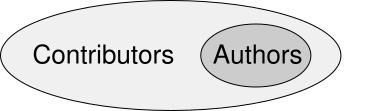
Fig. 1: Software authors represent a subset of software contributors. A person can have “author” status in addition to “contributor” status, meaning that any author is always also a contributor in a research software project but not vice versa.
This is independent of a particular expression of these roles, for example in the metadata for a research software project, where a person can be listed either as author or as contributor, or they can be listed as author and as contributor but not vice versa. There may also be differences between the authorship of the software, of a software paper, and other related research outputs, which are discussed below.
Academic Authorship
In these recommendations and guidelines, we exclusively discuss academic authorship of software. Authorship is an important concept in academia. It establishes transparency and enables credit and responsibility for the work, supports integrity, and helps build academic reputation and careers. Academic authorship is governed by codes of conduct that define good research practice. We consider our recommendations and guidelines to contribute to this definition. A violation of the rules that govern academic authorship may lead to charges of academic misconduct and sanctions against the violators.
In contrast to academic authorship, legal authorship is governed by general law, for example by copyright law, that establishes rules for intellectual property. These laws differ between different countries. A violation of the rules that govern legal authorship may lead to legal charges and respective punishment of the violators under the applicable laws.
Rules for academic authorship are generally complementary to rules for legal authorship and address research-specific rules that may not be detailed in general law. Nevertheless, the rules for academic authorship can become legally binding, e.g., through requirements for their institutional implementation as a precondition for eligibility to receive funding, as institutional by-laws, or as part of employment contracts.
The recommendations that we propose here build on existing codes of conduct for academic authorship by specifying recommendations for research software authorship. As such, they aim to inform and improve these codes of conduct, but are not legally binding and do not replace laws or institutional by-laws and other binding rules.
Who is an Author?
We recommend that software authorship be based on active contributions to the software. To qualify for authorship, a contributor must meet two criteria:
Their contribution to the software has been substantial.
Their contribution to the software has been in one or more of the four contribution areas.
The contribution areas that are relevant for authorship are:
the conceptualization of the software;
the source code, documentation and metadata, test code, setup or build configuration of the software;
maintaining the software;
safeguarding the continued existence or sustainability of the software project.
These four contribution areas are further explained below (see 2.2).
In contrast to authorship of textual research outputs such as articles or monographs1:
software authorship does NOT necessitate the production of persistent software artifacts such as source code, documentation or issue reports;
software authorship does NOT necessitate approval of software versions to be released or published;
software authorship does NOT by default establish accountability of individual authors for the software, beyond their individual contributions and any legal accountability.
All those designated as authors should meet the two criteria for authorship, and all who meet the two criteria should be identified as authors. Those who do not meet the two criteria due to the insubstantiality of their contribution should be acknowledged as contributors (see below).
The project team, software owner(s) or governance body for the software are responsible for identifying who meets the authorship criteria and when contributions are substantial, as well as the definition of additional authorship criteria for their specific software project.
If agreement cannot be reached about who qualifies for authorship, the legal owners of the software should be asked to investigate.
Non-Author Contributors
Contributors who do not meet the above criteria for authorship should not be listed as authors, but they should be acknowledged.
The Four Authorship Contribution Areas
Contribution area 1 (conceptualization of the software) includes work within the software project that defines the need, idea/concept, architecture and design of the software that will support its subsequent realization. Examples include ideation, user needs analysis, requirements engineering and software design.
Contribution area 2 (implementation of the software) includes work to create the usable software. Examples include software construction (“programming”) and testing, configuration management such as build and release engineering, software description such as documentation and software metadata work.
Contribution area 3 (maintaining the software) includes work to maintain the software. Examples include change management such as working with contributors to discuss and include changes, making new releases of the software, tracking and safeguarding software quality, conducting code reviews, migrating the software to new versions of platforms, retiring the software.
Contribution area 4 (safeguarding the sustainability of the software) includes work to ensure that the software continues to exist, and can be adapted to new use cases. Examples include securing continued funding for the software, managing the software project, managing the team working on the software, managing the community using the software, working with the stakeholders of the software, creating publicity for the software.
Authorship, Accountability and Governance
Software authorship differs from authorship of scholarly publications in some important aspects (see 2). Existing recommendations for authorship of papers require, for example, that authors “[agree] to be accountable for all aspects of the work in ensuring that questions related to the accuracy or integrity of any part of the work are appropriately investigated and resolved.” [4] In contrast, software authorship does not require all authors to take responsibility for addressing issues related to the quality or integrity of the whole software project.
One reason for this is that the factors of production and the nature of the output differ considerably between papers and software. In the vast majority of cases, papers are a static medium of limited size that is produced by a clearly defined and unchanging group of authors. Also, only one version of the paper is usually published, and is then considered to be final.
Software as an output, on the other hand, is dynamic by nature and itself generates output. Additionally, between multiple invocations of the same software, both its outputs and the set of software parts actually used at runtime may differ. It may even be argued that the software itself is a different one every time it is run. Over its lifecycle, the size of the software codebase may change considerably, while code is added, changed and removed. And finally, as it is developed further, different versions of the software may be published, each authored by a potentially different group of people.
Given these differences, it is not sensible to assume that all authors of one software version can be accountable for quality assurance of other versions (including versions published after the one they authored), or of parts of the software whose code they may have never read (including code that was removed in earlier versions). All authors are, however, individually accountable for all aspects related to their own contribution to the software project.
Consequently, if the scope of the contribution of individual authors is in fact the whole software project, they in turn are again accountable for safeguarding the quality and integrity of all aspects of the software. This applies, for example, when the software is authored by a single person, when the scope of individual authors’ contribution is either the whole software project, or when such accountability is specified via the contribution itself, e.g., for maintenance, quality assurance, release management, project leadership, etc. It follows that if authors are not accountable for the whole software or software version, they are also not generally required to approve a release or publication of the same.
Individual projects can decide to deviate from these general principles and set their own rules for accountability and for approval processes. As with all decisions related to the software project, these decisions and the rules for how they are made are part of the project governance. There are different models of governance for research software projects. The decision when to adopt one – and which one – must be made for each research software project individually on a case-by-case basis. Changes in how a project is governed may also be made more than once over a project lifecycle to adapt to changes in the project team, the project’s stakeholders, its community, its funding situation, increased adoption, etc. Some projects may start without formal structures and set clear policies later when it becomes necessary, others may benefit from having clear policies from the start.
Research software projects also always operate within a legal framework that takes precedence over project governance whenever project rules are in conflict with the law, or in cases where overriding interests require intervention, such as gross negligence or when harm is being done through the software. These cases then fall into the domain of case law.
Guidance for software projects
The definition of software authorship and the criteria and contribution areas outlined above provide a generic framework that should be applicable to all software projects. In practice, each software project will have to translate them into a policy that is suitable for the project and reflects its specific requirements. The following subsections discuss some of the central questions that software projects will have to answer for their case when defining their authorship policy.
Moving between roles
Roles during the development of research software can be as dynamic as the development itself. As the project progresses, contributors can become more engaged, leading to meaningful contributions that qualify for authorship (according to the criteria discussed above in 2.2). Likewise, some authors might cease to be authors if they stop contributing to the software project, or if their contributions are completely removed or replaced, e.g., in the software source code. Unlike scientific research publishing, which is static, the dynamic nature of research software allows for these changes in authorship.
Software projects should have clear guidelines that specify if and when a contributor can become an author, and vice versa, in what cases and when they would cease to be one. Software projects should also decide whether to adopt “project authorship” or “version authorship”, or another model.
In project authorship, individuals remain authors independently of their contributions to a specific version of the software until they no longer qualify for authorship within the scope of the software project. In this model, one-time contributions can qualify for authorship. Project authorship can also be accompanied by a stepwise process where people first become a contributor before they can qualify for authorship.
In version authorship, software authors are determined anew for each version of the software that is defined, released and/or published. In this model, authorship would be awarded based on substantial contributions to the specific version in question, not the software project as a whole.
While project authorship places emphasis on continuity, and version authorship places emphasis on current impact, the process for qualifying and disqualifying for authorship is the same for both models. In both cases, the governance body should clearly outline the authorship policy at the start of the project and make it available to all current and future contributors (see more about documenting authorship in 3.7).
Substantiality of Contributions
The authorship recommendations consider that a person will qualify as an author of the software if they have made substantial contributions to one or several of the aspects of the software (conceptualization, implementation, etc). However, what constitutes a substantial contribution needs to be clarified.
The following are some necessary prerequisites for contributions:
Contributions should be made with the intention to benefit the software project, and not as the means to a different end.
Contributions should represent the work of the contributor, and should not be derived from the work of third parties.
As mentioned before, it is up to every individual project to decide for themselves what may be considered a substantial contribution once the prerequisites for contributions are met. There are different options for processes to define substantiality, such as using a governance process to determine substantiality and authorship, tying authorship to specific roles that are seen to inherently contribute substantially (e.g., core maintainers), or using metrics for contributions based on, e.g., size, time spent, effort or continuity. When using metrics, projects should be aware that metrics can be manipulated and may fail to reflect the actual substantiality and effort of the contribution; projects should therefore also consider the intention behind contributions.
Note that there may be legal obligations to follow when determining authorship, independently of the process that is used for determining the substantiality of contributions. A specific example is where a publisher of a software paper may have specific rules for authorship, such as having responsibility for the entirety of the code, which may lead to the software paper having a different authors than the software project.
Group Authorship
Sometimes, publications and references use a group to comprise a set of individual authors. Examples of this include using a group name (“The ReSA Software Authorship Task Force”), or a role description (“The <software name> Developers”).
While this practice shows the intention to give credit even in those cases where it doesn’t seem possible or feasible to list all individuals, it is discouraged. As described above, defining authors should enable credit. It is a software citation principle that “software citations should facilitate giving scholarly credit and normative, legal attribution to all [authors of] the software.” [6] Group authorship obfuscates the individuals that have made contributions to the software that qualified them for authorship. While group authorship might be used in some cases, for instance in social media publications or other non-formal communication channels, software projects should refrain from using only group authorship when providing author information about their project. They should define a process for determining and recording individual authorship and providing it in the source repository of the software or elsewhere.
Some academic disciplines or projects may have established group authorship as standard practice. We recommend that these adopt individual authorship in their guidelines.
Authorship of Forks
Forked versions of a codebase may be developed further independently of the original codebase, ultimately leading to two different codebases that share the same origin. Determining the authorship of forks may seem like a complex task, but fundamentally, the same principles and guidelines apply as for any other research software project. Following good practice under the principles of academic authorship, this means that the authors of the original codebase initially are the authors of the forked version. As development of the fork continues, and substantial contributions are made to the fork, authorship evolves. The granularity and pace of this evolution depends on the authorship model that the fork project adopts, on the scope of the new contributions to the fork, and on the scope and lifetime of the contributions made by the original authors.
There are some cases where determining the authorship of a forked research software needs careful attention. For a specific example, as governance of the fork lies with the fork project, it may choose to adopt an authorship model (see 3.1), where the authorship is based exclusively on substantial contributions to a specific version. This way, the original authors of the fork source may in theory be replaced by a new set of authors as a new (major) version of the fork is released. We strongly recommend that in this specific situation, projects take extra care to practice due diligence in terms of good research practice, and to carefully follow legal copyright requirements. This is especially crucial if the fork has been created due to conflicts in the project community, and the incentive for crediting members of the original community may be reduced.
As the fork is a derivative of the original codebase, we also recommend in any case that projects make this relation transparent by citing the original codebase from their software.
Authorship of Work Related to the Software
The authors of a software may differ from the authors of other work that is related to the software, such as a journal article that describes the software or a software paper published in a software journal (e.g., the Journal of Open Source Software (JOSS) 2. These works are separate works from the software, and their authorship must be established independently of the authorship of the software.
As per the software authorship criteria, individuals who have contributed solely to a journal article about the software, but not the software itself, are not authors of the software. Vice versa, authors of the software who have not contributed to the article are not authors of the article.
Software papers are also separate works from the software itself, although they are more closely linked to the software than a traditional journal article. The review process for software papers usually includes a review of a specific version of software as well as of any accompanying written work. Sometimes, these reviews also suggest or require changes in the software under review. Software journals may have their own guidelines for authorship of the software paper that can lead to a different set of authors for the software paper than for the software itself. For software papers, we recommend that all authors of the specific software version that is being reviewed for the software paper are also listed as authors of the software paper.
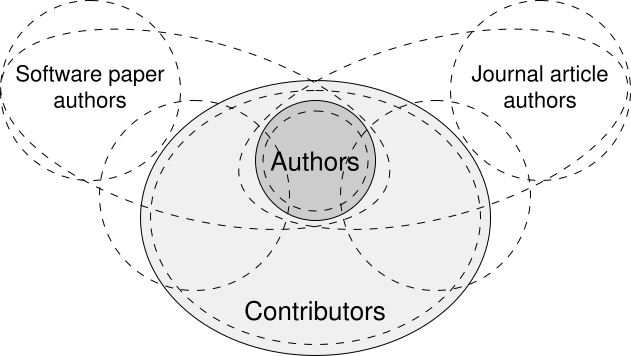
Fig. 2: Some of the potential set relationships between software authors and contributors, and authors of works related to the software.
Generative and Agentic Artificial Intelligence Tools cannot be Software Authors
Large language models can create output that supports software development and engineering activities. Agentic tooling built around such models can interact with existing codebases, change existing code and generate new code and other artifacts. Some agents can also commit to version control systems and add themselves as “co-authors” of such commits. Despite this, neither large language models, nor agents and other tools used to leverage the output of such models can be software authors.
Large language models, tooling to interact with them, and agents, are software tools that are ultimately activated, controlled and steered by a human. They are inherently reactive and not active. They do not create or maintain software of their own volition or creative intent. They do not ideate novel contributions to research software. Without legal personhood, they also cannot hold copyright, transfer rights and be credited as an author in a legal sense. Courts and copyright offices consistently tie authorship exclusively to human creativity and intent and reject the notion of non-human authorship3. Scientific publishers also consistently allow the use of generative AI tools for improving content but not creating it, and some disallow the listing of such tools as authors altogether.
If generative or agentic AI tools are used in your project, and substantial parts of their outputs are integrated in the software – either unmodified, or after modification by human contributors – we recommend that you disclose this in your software documentation. This can be done, for example, in an AI Declaration Format [5] file, or in a similar format. In addition, you can cite the tools and models that your project has used as a reference from your software, if you consider them relevant previous work. This can be done, for example, in a Citation File Format [3] or CodeMeta [1] file, or in a similar format.
How to Document the Authorship Policy for Software Projects
How you apply authorship criteria in detail is specific to your project. You may extend the contribution areas, or use a subset. In any case, your software project should openly document how you handle contributions with respect to authorship. The respective documentation should be accessible from where contributions are made. In many cases, the documentation of the authorship policy should be kept in the source code repository. It should be linked from, or included in, other potential entry points for contributors, such as templates for pull requests/merge requests and issues, and relevant documentation.
The authorship policy should be documented in a dedicated file, e.g.,
AUTHORSHIP(.md/.txt) and should be saved in the same place as
similar documentation. This file should make clear
for each of the four contribution areas, the concrete types of contributions to the project that qualify for contributorship, and which can qualify for authorship;
the general authorship strategy the project uses (project authorship, version authorship, something else);
the threshold for the substantiality of a contribution for each of the four contribution areas to qualify for authorship;
vice versa, when/under which circumstances contributors cease being authors;
the legal prerequisites that apply with regard to authorship in the specific project (e.g., do national laws apply, and if so, which ones);
if and how information about current authors is recorded and publicized;
if and how past authors are acknowledged;
how decisions about authorship are made, and how conflicts with regard to authorship are resolved.
We provide a template for an authorship policy document that projects
can use and adapt below, and at
https://researchsoft.org/tf-authorship-contribution/AUTHORSHIP.md.template.
Text in angle brackets (<>) represents a
placeholder and should be replaced. Text in square brackets
([]) divided by a vertical bar
(|) represents examples, or options, of which
suitable ones should be chosen.
Authorship Policy Template
|
Acknowledgements
We would like to sincerely thank the following individuals for contributing their expertise during the expert review phase for the initial version of these guidelines:
Daniel S. Katz (University of Illinois Urbana-Champaign)
Javier de la Cueva (javierdelacueva.es)
Melissa Harrison (EMBL European Bioinformatics Institute)
Néstor de la Paz Ruiz (University of Twente)
Pamela Wochner (Delft University of Technology)
Will Riley (Wageningen University & Research)
We would also like to acknowledge the Research Software Alliance’s support for the work of this task force, as well as the Institute for Research Software (previously the Software Sustainability Institute (SSI)) as organizer of Collaborations Workshop 2023, where this work was started. The work carried out by the Institute for Research Software is funded through the UKRI Digital Research Infrastructure Programme through grant number AH/Z000114/1.
SD’s work was supported by the Lower Saxony Digital Science Support Space (DS³) project as part of Hochschule.digital Niedersachsen, funded by zukunft.niedersachsen. JC received funding inside the Open.Make project funded by the Federal Ministry of Education and Research (BMBF) and the state of Berlin under the Excellence Strategy of the Federal Government and the Länder / Berlin University Alliance, and from the project “LAUDS Local Accessible Urban Digital Sustainable Factories is a Horizon Europe research and innovation action” co-funded by the European Union, 2024-2026, GA 101135986.
Related Resources
- Google Casebook “Authorship in Open Source”: https://google.github.io/opencasebook/authorship/
References
- C. Boettiger et al. 2025. CodeMeta: Minimal metadata schemas for science software and code, in JSON-LD. url:https://github.com/codemeta/codemeta.
- S. Druskat, N. Chue Hong, J. Colomb, H. Gruson, S. K. Bhogal, C. Martinez-Ortiz, and G. Turon. 2026. Research Software Authorship. (2026). doi:10.5281/zenodo.22834408.
- S. Druskat, J. H. Spaaks, N. Chue Hong, R. Haines, J. Baker, S. Bliven, E. Willighagen, D. Pérez-Suárez, and A. Konovalov. 2021. Citation File Format. doi:10.5281/zenodo.5171937. url:https://citation-file-format.github.io.
- International Committee of Medical Journal Editors. 2026. ICMJE Recommendations: Defining the Role of Authors and Contributors. url:http://web.archive.org/web/20260918032438/https://www.icmje.org/recommendations/browse/roles-and-responsibilities/defining-the-role-of-authors-and-contributors.html#two.
- ReSoft Labs B.V. 2026. AI Declaration Format. url:https://ai-declaration.org/.
- A. M. Smith, D. S. Katz, K. E. Niemeyer, and FORCE11 Software Citation Working Group. 2016. Software citation principles. PeerJ Computer Science, 2, e86. doi:10.7717/peerj-cs.86.
- U.S. Copyright Office. 2025. Copyright and Artificial Intelligence, Part 2: Copyrightability. Report of the Register of Copyrights. U.S. Copyright Office, (Jan. 2025). url:https://www.copyright.gov/ai/Copyright-and-Artificial-Intelligence-Part-2-Copyrightability-Report.pdf.
- U.S. Copyright Office. 2023. Copyright registration guidance: works containing material generated by artificial intelligence. 37 CFR Pt. 202; Statement of Policy. (Mar. 2023). url:https://www.federalregister.gov/documents/2023/03/16/2023-05321/copyright-registration-guidance-works-containing-material-generated-by-artificial-intelligence.
See, e.g., the definition by the International Committee of Medical Journal Editors (ICMJE) [4]. ↩︎
See the copyright registration guidance rule by the U.S. Copyright Office [8]: “Most fundamentally, the term ‘author,’ which is used in both the Constitution and the Copyright Act, excludes non-humans.” The report Copyright and Artificial Intelligence, Part 2: Copyrightability [7] provides detailed discussion for further reference. ↩︎